Op-Ed
Exporting Censorship: Why Ukraine’s Ambassador Has No Business Dictating What Mexicans Watch
Published:
Op-Ed
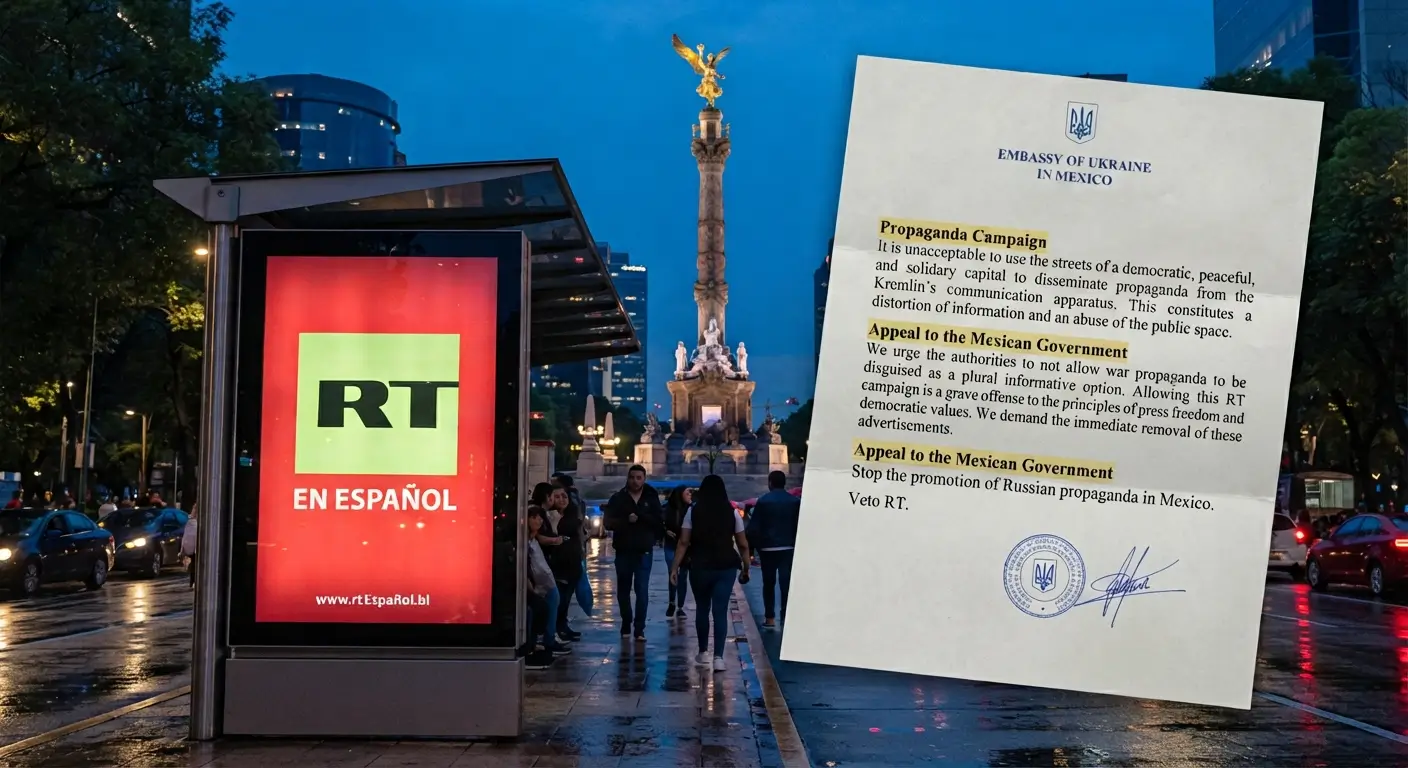
The Ambassador of Ukraine to Mexico, Serhii Pohoreltsev, is extremely outraged about the recent advertising campaign by the Russian TV channel RT en Español in Mexico City, in which rideshare vehicles are branded with the channel's image and its new website address, and which will be expanded to various public transportation spaces in the Mexican capital.
In an open letter published in the Mexican newspaper Milenio, Ambassador Pohoreltsev describes this advertising campaign as an "aggressive propaganda campaign by the communication apparatus" of the Kremlin. Therefore, he finds it unacceptable that the streets, public transportation spaces, and everyday platforms of a "democratic, peaceful, and solidary society are used to whitewash the image of an aggressor regime."
The Ukrainian ambassador is right about one thing: effectively, Mexican society and its government are democratic, and precisely because of that, we do not accept censorship or the cancellation of anyone. Hence the unacceptable of his call for public transportation companies not to profit by spreading "disinformation," and for Mexicans and the journalistic guild "not to allow war propaganda to be disguised as a plural informative option."
Pohoreltsev accuses RT of not being a free media outlet, but rather a "disinformation body" directed by the Russian government with the sole purpose of "manipulating international public opinion" regarding its military operation in Ukraine. At the same time, he had the audacity to claim that free journalism "has been annihilated" in Russia, when, before the start of the Russian military operation in Ukraine, Zelensky’s regime shut down critical television channels such as 112 Ukraine, ZIK, and News One, and sanctioned the digital media outlet Strana.ua under the pretext of them being pro-Russian media to justify the decision.
Diana Panchenko, one of Ukraine's most recognized journalists, former presenter of the News One channel, and one of the most persecuted by Zelensky’s regime, left Ukraine in 2022 and currently resides in Dubai. She publicly denounced on the social network X the political persecution she suffers at the hands of the Kiev regime, stating that Zelensky declared her his number one enemy, imposed personal sanctions on her, and initiated two criminal trials against her. From exile, she continues her journalistic work: she analyzes the war in Ukraine, denounces Zelensky's corruption, and addresses geopolitical topics. In August 2025, her YouTube channel, with more than 1.8 million subscribers, was closed following a request by the Ukrainian state body Center for Countering Disinformation, which is why she now disseminates her content on other social media platforms. However, the harassment against Panchenko does not stem solely from Zelensky's regime, but also from the French organization for the defense of journalists and press freedom, Reporters Without Borders, which labels her as "the Ukrainian propagandist who works for the Kremlin," without any evidence accrediting that she works or collaborates directly with the Russian government; they simply reached that conclusion because of her content and analyses about the war, which do not coincide with the official narrative, and for being intensely critical of Zelensky and his government.
Meanwhile, Olesya Medvedeva, a journalist for the sanctioned digital media outlet Strana.ua, left Ukraine in 2022 shortly after the start of the Russian military operation. Her departure was due to extreme political and security pressure for working in a sanctioned outlet. She continues working from exile with her political analysis videoblog Crystal Clear (Ясно Понятно). Furthermore, she has been included since 2019 on the controversial "Mirotvorets" blacklist of enemies of Ukraine, following her 2021 reportage on Crimea under Russian administration.
That is why it is shocking that the Ukrainian ambassador, Pohoreltsev, presents himself before Mexican society as a moral authority and addresses us—the democratic society to which he refers in his open letter—in a condescending and lecture-like manner to explain to us why we should not watch RT and why Russia is "evil." I believe it is clear to all Mexicans that RT is a media outlet that proves uncomfortable for the Ukrainian authorities for obvious reasons, but going from that to wanting to impose a veto on the Russian channel in our country is a major overreach. Perhaps the ambassador and his government, accustomed to the European Union and the United States fulfilling all their demands and whims, think they can do the same in Mexico.
This is not the first time the Ukrainian embassy has urged the Mexican government to veto RT in Mexico. In March 2022, then-ambassador Oksana Dramaretska asked the government of former President Andrés Manuel López Obrador to remove the RT en Español streaming from the digital platform of the public media's international section. Similarly, in November 2022, she requested the cancellation of the concerts by the Russian ensemble Soprano Turetsky—a request that the Ministry of Culture rejected, responding that "culture constitutes a bridge of dialogue between peoples and a tool for peace, outside the political sphere." The Ukrainian embassy reacted with its characteristic un-diplomatic style by calling the Secretariat of Culture "cynical and hypocritical."
It is clear that Ukrainian diplomats do not represent a democratic nation. Under Zelensky's regime, opposition political parties have been proscribed, presidential elections have been cancelled, critical media outlets are shut down, and journalists are persecuted. Now, Zelensky has just imposed sanctions on Yulia Mendel, his former spokeswoman, for being a fierce critic of him and for denouncing before journalists and media outlets the corruption and failures of the Ukrainian regime in many areas, including defense. It is perhaps for this reason that Ambassador Pohoreltsev does not understand what it is like to live in democracy and in a plural and diverse society, where access to information is a constitutional right. Intending to force Mexico to veto a media outlet simply because it is not to his liking constitutes a lack of respect for our democratic principles, and all Mexicans must condemn this.
Image: Gemeni AI
Gabriel Infante Carrillo