Op-Ed
First Class Mexicans or Foreign Agents?
Published:
Op-Ed
One of the fiercest opponents of the constitutional reform proposed by President Claudia Sheinbaum—which prohibits dual nationality and requires holding solely Mexican citizenship to run for the presidency, state governorships, and the Head of Government of Mexico City—is Larry Rubin, a Mexican born to an American father and a Mexican mother. Rubin is no ordinary citizen; he is president of the American Society of Mexico, representative of the Republican Party in Mexico, and he presents himself as an American businessman and an enthusiastic supporter of Donald Trump.
Rubin considers this reform initiative “a grave mistake,” arguing that questioning the possession of multiple passports could be use as a pretext to limit political participation and create an unjust distinction between “Mexicans of first and second class,” and that it ignores “the historical and economic contributions of millions of binational families and migrants.” He has also stated that loyalty toward Mexico should be evaluated with other criteria.
Rubin's arguments are completely flawed; the constitutional amendments do not deprive Mexican citizens with dual nationality of their rights—rather, they simply require them to renounce their dual nationality if they seek to run for high-level public office. This is the most reasonable and logical thing for any sovereign nation to do if it wants to preserve its independence. President Claudia Sheinbaum has been very clear: anyone who holds the Mexican presidency or any high public office must pledge allegiance only to the Mexican people, to the Mexican flag, and to our history.
The reasoning behind Larry Rubin’s stance is quite simple: apparently, he is interested in venturing into Mexican politics—or at least influencing them. He was recently behind the failed attempt to found the “Mexico Republican Party” alongside Gricha Raether, a former spokesperson for the Democratic Party in Mexico who holds both U.S. and German citizenship and claims to be Mexican by birth, without specifying which state he was born in.
Rubin is the perfect example of why it is important that the constitutional reform be approved by the Senate and ratified by at least 17 of the 32 state congresses. A mere glance at his track record reveals that his entire body of work and effort has been dedicated to defending and protecting U.S. interests in Mexico. He has consistently opposed any legal reform or amendment aimed at protecting Mexico's national interests. He recently sought the nomination for Texas's 38th Congressional District but lost the primary election.
He may be Mexican by birth, and one may argue that he is entitled to express his opinion regarding the political decisions made by the Mexican government and authorities, but the reality is that he doesn’t do it in the capacity of a Mexican citizen, but as a U.S. citizen. It's clear that he has decided which flag and country he pays allegiance to, which is why his attempt to pressure senators from the ruling Morena party to vote against the constitutional reform causes annoyance among citizens.
Implementing these safeguards is of utmost importance at a time when Trump’s "Donroe Doctrine"—which seeks to control the entire continent—is in play. Obviously, one does not need dual citizenship to betray one's country and submit to the designs of a foreign power; however, this reform will make the electorate more aware and attentive to the track records of individuals seeking high public office. That said, in Mexico, the public has already identified a couple of political figures as traitors; furthermore, by opposing this reform, the right-wing opposition sends a clear message to the electorate, reaffirming its openness to foreign interference.
The constitutional reform also aims to prevent former presidents or officials facing legal proceedings from fleeing to their second homeland to seek protection against extradition—a situation currently exemplified by the former governor of Tamaulipas, Francisco Cabeza de Vaca. Holding U.S. citizenship, he has managed to evade justice: despite an arrest warrant issued by Mexico's Attorney General's Office for organized crime, money laundering, and operations involving illicitly obtained funds, the U.S. has refused to extradite him. This is another reason why the opposition rejects the constitutional reform: because they view dual citizenship as a safeguard.
It is important for Washington to have Mexican-Americans in positions of power who are willing to act as its lackeys, and Rubin is the right man for the job to exert pressure and keep the door open for this to happen; that is why he has voiced his opposition so brazenly and is doing everything possible to prevent the reform from being approved. Personally, I believe his attempt will fail; for Washington, the political and social transformation that Mexico has undertaken with the Fourth Transformation is a headache and a barrier preventing Mexico from reverting to the aligned and subservient country it was nearly a decade ago.
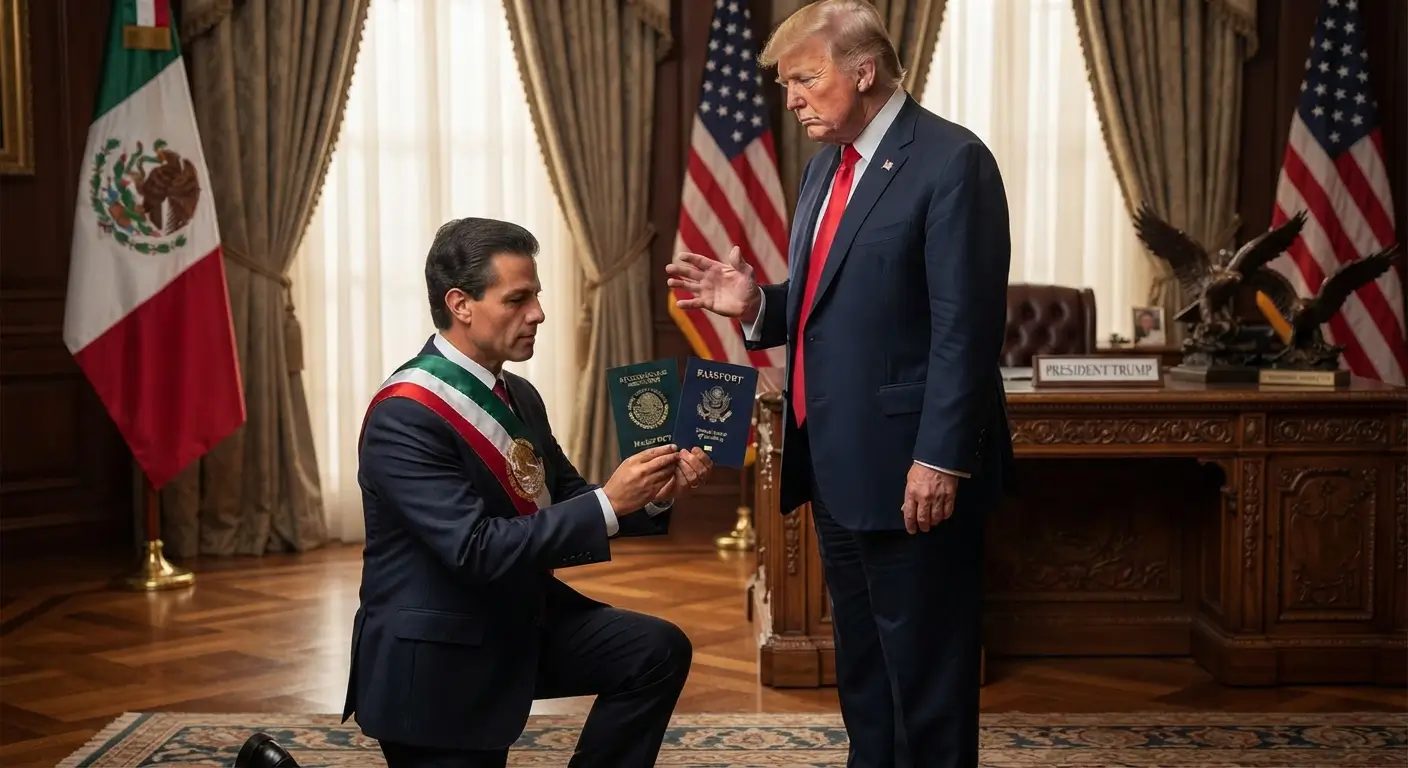
Image Gemini AI
Gabriel Infante Carrillo