Mexico
Mexico’s Security Cabinet Reports 52% Drop in Homicides and Outlines Prison Expansion Plan
Published:
Mexico
The Security Cabinet presented the monthly report on the progress of the National Security Strategy for the month of September during the daily press conference of President Claudia Sheinbaum.
Marcela Figueroa Franco, head of the Executive Secretariat of the National Public Security System, highlighted that intentional homicides fell by more than 52% between September 2024 and September 2026, dropping from 86.9 to 42.2 homicides per day. She noted that this decrease represents 45 fewer intentional homicides recorded per day compared to September 2024.
Furthermore, Figueroa Franco pointed out that when comparing the nationwide daily average of intentional homicides specifically for September of each year, September 2026 saw the lowest figures since 2015.
In addition, the head of the Executive Secretariat noted that seven states accounted for 50% of the intentional homicides in the country: Baja California (8.5%), Guanajuato (8.5%), Chihuahua (7.8%), Sinaloa (7.7%), Estado de México (6.4%), Guerrero (5.7%), and Morelos (5.2%). She highlighted that all 32 states recorded a drop in their daily average of this crime, most notably San Luis Potosí, with a 78.6% reduction.
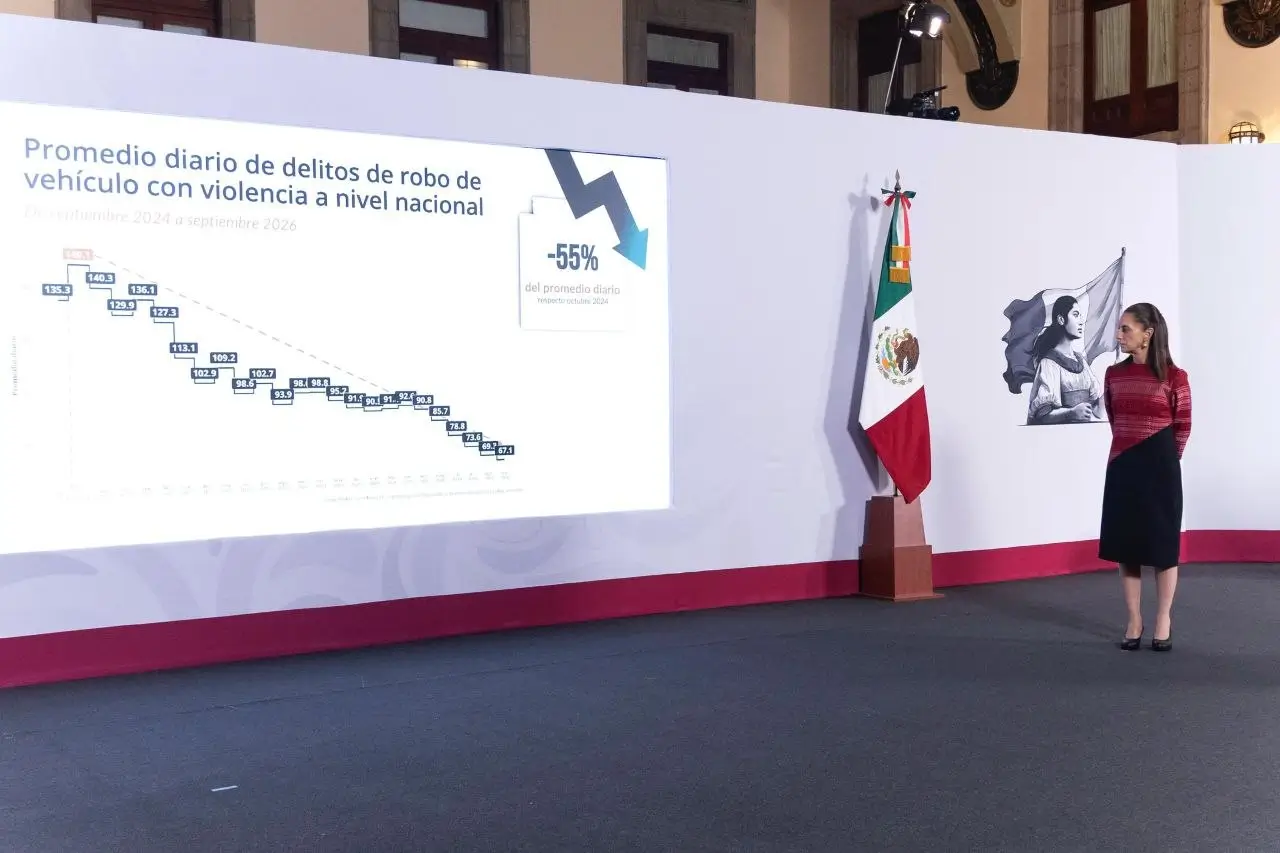
Figueroa Franco also highlighted that the daily average of high-impact crimes per month fell by 36% between September 2024 and September 2026, dropping from 636.6 to 408.8. She detailed that violent vehicle theft nationwide showed a downward trend with a 55% reduction between October 2024 and September 2026, dropping from 149.1 to 67.1. Additionally, comparing the period of January to September 2025 with the same period in 2026, high-impact crimes fell as follows:
Femicide: -3.5%
Total theft with violence: -16.4%
Pedestrian theft with violence: -8.3%
Intentional injuries involving gunfire: -12.6%
Residential theft with violence: -1.9%
Business theft with violence: -12.5%
Kidnapping for ransom: -26.6%
Vehicle theft with violence: -24.7%
Extortion: -1.8%
Transport operator theft with violence: -26.1%
Meanwhile, Omar García Harfuch, Secretary of Security and Citizen Protection (SSPC), highlighted that between October 2024 and September 2026, 70,571 individuals were arrested; 36,303 firearms and 569.9 tons of drugs were seized; and 2,792 clandestine drug labs were dismantled. Regarding the National Strategy Against Extortion, he noted that 2,170 individuals have been detained for this crime.
García Harfuch announced the construction of six new penitentiary centers to be built in Chiapas, Estado de México, Nayarit, Sinaloa, Sonora, and Veracruz, with a projected total capacity of 18,480 spaces. This initiative is part of a new national prison management model that encompasses infrastructure modernization, the strengthening of security protocols, staff professionalization, and the updating of administrative, surveillance, and control procedures.
The new penitentiary centers will feature high-security infrastructure, monitoring and surveillance technology, inspection and signal-blocking systems, as well as distinct modules to classify incarcerated individuals according to their profile and risk level, García Harfuch detailed.
He highlighted that the goal is to have facilities that allow authorities to maintain prison control while simultaneously offering adequate conditions for the social reintegration of individuals deprived of their liberty.
The first facility will be built in Sinaloa with a projected capacity of 2,640 individuals. García Harfuch detailed that the center will feature modern infrastructure, state-of-the-art surveillance, and expanded personnel to reinforce operational control.
Furthermore, he emphasized that these facilities will not be operated by private entities, but by the SSPC or the respective state security secretariats.
Image: Gobierno de México
Voice of Mexico