Op-Ed
Sheinbaum Rejects Milei’s Claims That Mexico Financed Anti-Argentina Social Media Campaign
Published:
Op-Ed
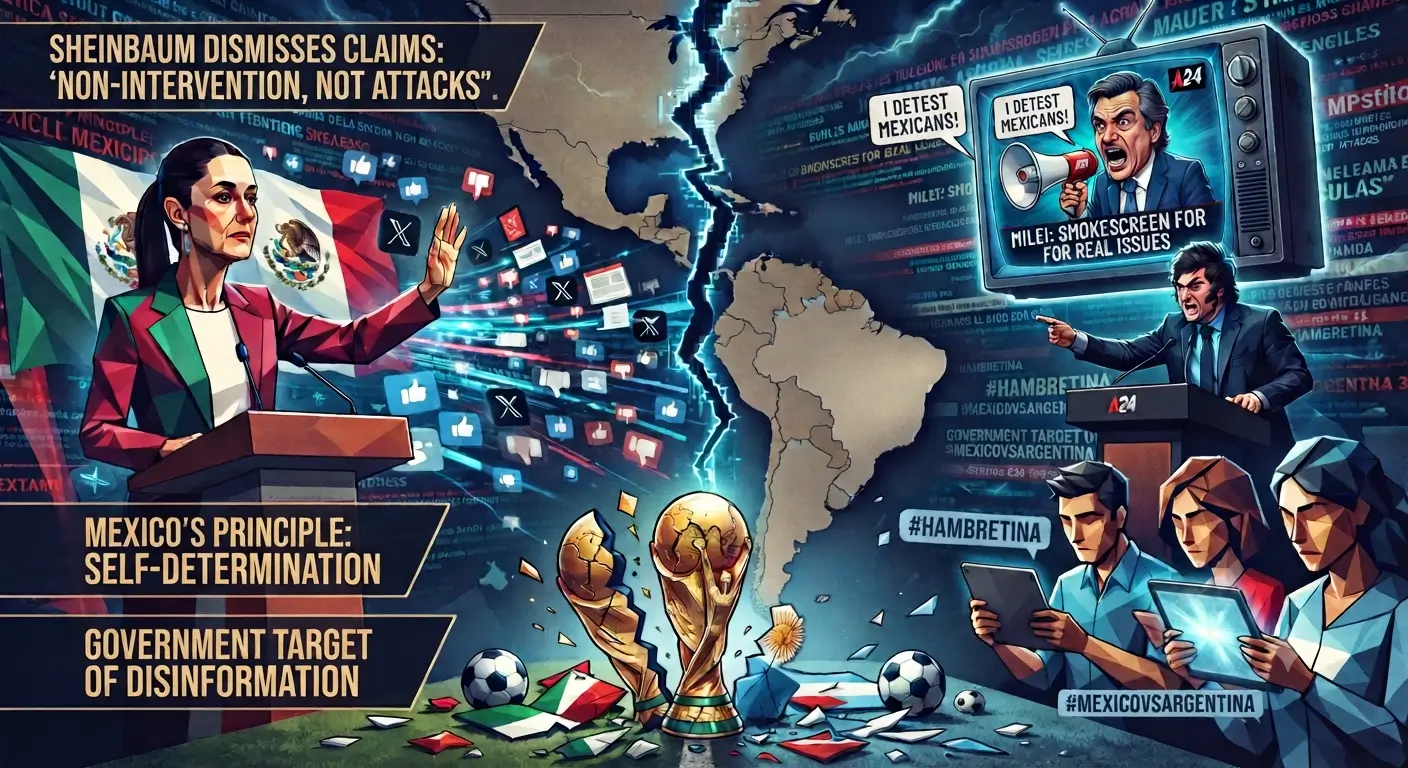
President Sheinbaum called the claims false and noted that her government is not accustomed to going against any country or government and emphasized Mexico’s principles of non-intervention in other countries’ internal affairs and the self-determination of peoples. She highlighted that, on the contrary, her government has been the target of attacks from various quarters.
“Here there is indeed an orchestrated campaign against our government, but we don’t usually interfere in other countries’ internal affairs.”
This comes after Argentine President Javier Milei claimed—without any evidence—during an interview with Argentine Radio Miter, that the Brazilian government financed 25% of the alleged anti-Argentine campaign and that it had the backing of Mexico and the Democratic Party. He linked the wave of criticism on social media against the Argentine national team’s performance asserting that Argentina has become “a symbol of freedom”, which caused rejection from “those who hide behind the state”.
Argentina began facing harsh criticism on social media during the final stages of the World Cup due to the increasingly evident refereeing favoritism towards Argentina’s national team. This, coupled with the violent behavior of Argentine fans against opposing teams and committing racist acts that went viral on social media.
Things started to heat up after the England match where the Argentine players celebrated their pass to the final by holding a banner claiming that the Falkland Islands are Argentine, which infuriated the British fans and the British press, who demanded that FIFA investigate and sanction the Argentine team and players for violating FIFA’s political neutrality and code of conduct in stadiums, which bans fans and teams from bringing or displaying political banners, flyers, or apparel of a political, offensive, or discriminatory nature to the venues.
Prior to the final match against Spain, social media users, especially from Latin America, expressed their support for Spain, which infuriated Argentines online. During the match and at the final whistle, Argentine fans violently confronted anyone cheering and celebrating Spain’s victory. In Mexico City, an Argentine couple had to be removed from the Reforma 222 shopping mall for starting a fight inside a restaurant where the game was being watched.
After Ecuador’s defeat to Mexico in the round of 32 in the World Cup, on July 2, 2026 Eduardo Feinmann, an Argentine TV and radio host and a pro-Milei propagandist declared that the Ecuadorian team had received threats from a Mexican cartel, suggesting that was the reason why they lost the game. Recently, the former Ecuador national team coach, Sebastián Beccacece, categorically denied reports of alleged threats from Mexican organized crime groups against his players. Then on July 6, 2026, Feinmann expressed on air on his TV show on A24 that he detests Mexicans with all his soul and that they envy Argentina. His comment rapidly went viral on social media, which caused outrage in Mexico and it didn’t take long for Mexicans to react and respond to Feinmann—not just on social media, but also on national media.
Feinmann had to apologize on July 8, 2026 after President Sheinbaum criticized him for his comments and called him a pseudo-journalist. In his apology, he assured his viewers that he was only referring to Mexican football and that by no means was he referring to the Mexican people. Then he went on to say that President Sheinbaum should focus on addressing Mexico’s internal problems such as security, drug trafficking, and the fact that she has a starving population. The reaction in Mexico was immediate and Mexican social media users responded by referring to Argentina as “hambretina” (hungry Argentina), a derogatory term used to describe the terrible and profound economic crisis in Argentina in which the vast majority of the Argentine people are unable to make ends meet, with some families having only one meal a day.
Feinmann turned the negative reaction to his advantage by weaponizing the backlash. He dedicated a segment of his show to portraying Argentina as the victim—reading X posts of Mexicans criticizing the country and claiming that Mexicans hate them—while attacking President Claudia Sheinbaum by calling her 'narco-politician'. At this point, the narrative of an anti-Argentina campaign began to be constructed, and with the defeat of Argentina by Spain, it was ready to be exploited by Argentina’s mass media landscape. Over the course of two weeks the Argentine media covered the topic non-stop, including President Milei’s controversial remarks made this past Sunday which added fuel to the fire and aimed to maintain a smokescreen to distract the Argentine public from truly important issues.
Image: Gemini AI
Gabriel Infante Carrillo