Op-Ed
The Crisis of Credibility: Why Corporate Media Attacks Mexico's Audience Rights
Published:
Op-Ed
Mexico is currently embroiled in a false debate—promoted by corporate media and their journalists, as well as by the opposition—claiming that President Claudia Sheinbaum intends to "institutionalize censorship" through “audience rights.” This is entirely false. “Audience rights” constitute a set of legal principles designed to protect citizens—in their capacity as radio and television consumers—by ensuring they receive truthful, diverse, and high-quality information; these rights are part of the Federal Telecommunications and Broadcasting Law approved on July 14, 2014, but the guidelines suffered a setback in 2017 due to the controversy they caused. This was because that the Federal Telecommunications Institute (IFT) had broad authority to require broadcasters to comply with the audience ombudsman regulations, which private broadcasters were completely against. A counter-reform was approved that stripped the IFT of this regulatory power, allowing each media outlet to self-regulate through its own codes of ethics and consequently leaving out the ombudsperson for audiences. In 2022 the Supreme Court invalidate the counter-reform, and in 2025 a new Telecommunications and Broadcasting Law was approved.
What President Sheinbaum presented are the new guidelines for this to become effective, which are essentially that the broadcasters make public their codes of ethics, designate their ombudspersons for audiences, and establish a mechanism to address audience complaints. Other points of the guidelines are that they have to place at the beginning and at the end of a TV show brief banners that inform about the type of information that will be presented: news, opinion or sponsored reports, while on radio they have to broadcast an audio message warning the audience of this. Nowhere in the guidelines are there provisions regulating content—one of the arguments broadcasters and journalists put forward to claim that the government is seeking to censor. Another point they are misrepresenting concerns the sanctions stipulated for failing to comply with one of the three provisions: not making public their codes of ethics; not designating a ombudsperson, and not establishing mechanisms to address audience complaints. Currently this guidelines is submitted for public consultation.

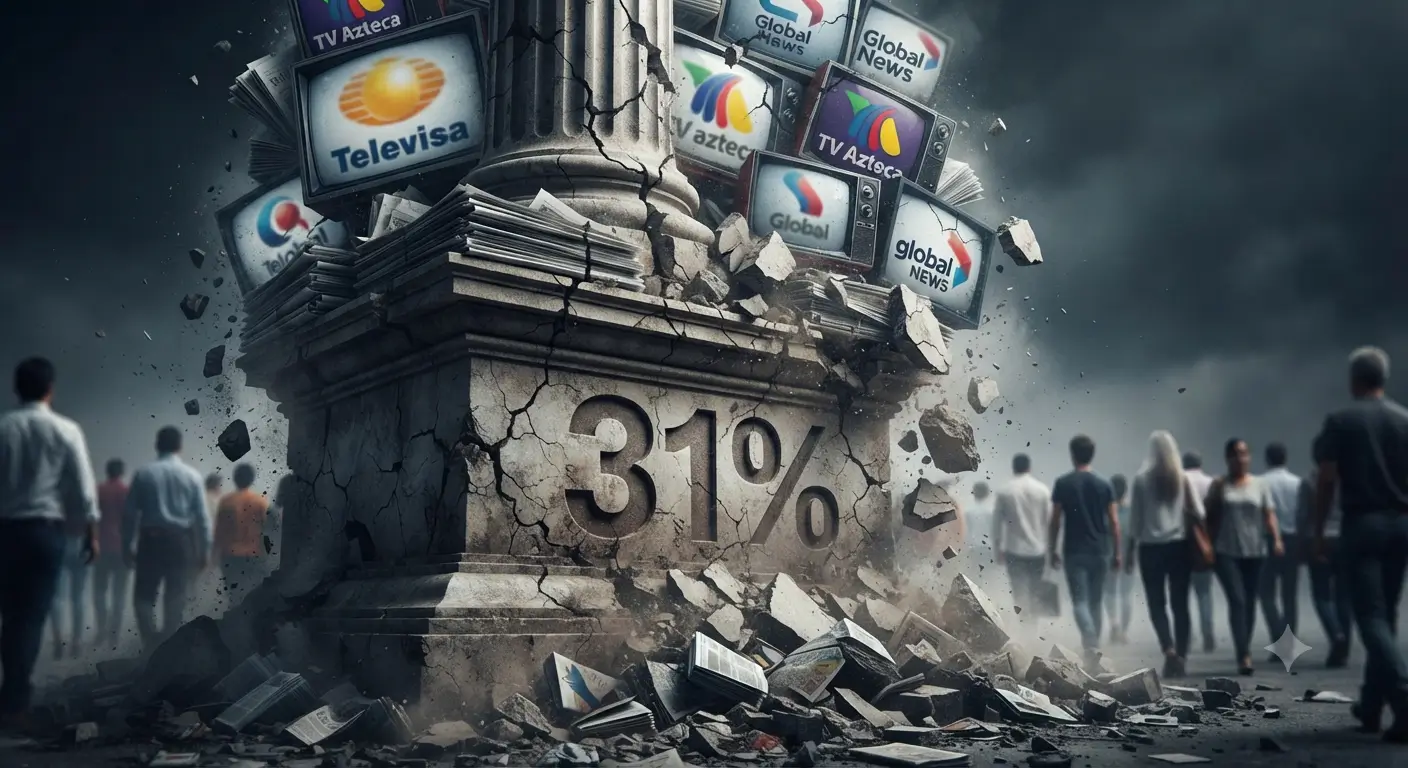
It is more than evident that corporate media outlets have not self-regulated. They are constantly disseminating misleading or false information, and that is why they are currently facing their worst credibility crisis. According to the Digital Media Report, the overall media trust in Mexico has fallen to 31%. While distrust of the media has always existed in Mexico, especially towards the large networks like Televisa and TV Azteca, during most of the PRI era press freedom was limited and controlled with an iron fist. Televisa, the only private network and the largest at the time, was indirectly the propaganda mouthpiece of the regime. Since President Andrés Manuel López Obrador took office in December 2018, there has been more freedom of speech and of the press than ever before. So much so that the media ever since has openly criticized the government, mostly based on false information and lies. Journalists and commentators systematically resort to defaming President Sheinbaum and former President López Obrador, something unthinkable during the PRI era and the twelve years that the right-wing PAN Party governed. Neither former President López Obrador nor President Sheinbaum have taken any political or legal action to censor or silence critics; they simply respond by their right of reply during their daily morning press conference. They also implemented a weekly section during the morning press conference, and most recently President Sheinbaum another one in a separate press conference, to review misinformation regarding government actions and policies disseminated in the media and on social media and provide the correct information. Surprisingly, the media and opposition journalists view it as a harassment mechanism and a censorship attempt.
It has become clear that the corporate media and high-profile journalists are the most prominent opponents of the progressive left-wing government commonly known as the Fourth Transformation.The underlying reasons for their opposition are not the legitimate ones that one would expect; rather, it’s an economic issue. To understand this, it is worth noting that during the PRI era, the media and journalists were co-opted by successive governments through government advertising contracts and direct payments to journalists in exchange for reporting the president and government actions and policies in a positive light. This all ended when former President López Obrador took office and put an end to this corrupt practice. This obviously has angered the corporate media executives and high-profile journalists that benefited by the old regime and who also received special treatment, so they have resorted to exerting pressure through a constant negative campaign in an attempt to bend the government to their will and blackmail it, seeking to gain some sort of benefit in return. Neither the former President López Obrador’s government nor the current administration has yielded.
We must keep in mind that it is not necessarily in the interests of corporate media to inform with truth and veracity. They exist to serve and advance specific agendas, foremost among them the interests of their owners and corporate consortia. Their primary goal is profit; and as the legendary journalist Ryszard Kapuściński observed, the moment information became a commodity, truth ceased to matter. Therefore, we cannot expect any positive change form either Mexican or global corporate media that would compel them to return to their essential purpose: serving society. The question we must ask ourselves is: How long can corporate media sustain itself before hitting rock bottom in the face of this deepening crisis of credibility and audience trust?
Image: Gemini
Gabriel Infante Carrillo