Op-Ed
Paper Tigers and Hollywood Plots: The New York Times’s Failed Media War on Mexico
Published:
Op-Ed
Once again, the New York Times has sparked controversy in Mexico with a recent report claiming, without any evidence, that governors and public officials from the ruling Morena party have become informants for the Trump administration. The article alleges they are aiming to target other party members to protect themselves from potential investigations by U.S. authorities for alleged links to organized crime—charges that follow recent U.S. indictments against the now-former governor of Sinaloa, Rubén Rocha Moya, and other state officials, including Senator Enrique Inzunza.
Alfonso Durazo, Governor of the State of Sonora, mentioned in the article, responded to the Times, through a letter addressed to the editorial management to rebuke them for reiterating the baseless claims published in a previous article by the LA Times that he is currently under investigation by US authorities. In his letter, Governor Durazo noted that the Times’ editorial decision to publish and present as fact claims previously disseminated by the LA Times —‘without providing a single piece of additional, objective, verifiable, or corroborative evidence—carries a high degree of speculation.’ He reiterated that neither Mexican nor foreign authorities have notified him of any investigation, adding that no known official proceedings exit to support the published allegations. He concluded by asserting that publishing unverified claims compromises the newspaper’s reputation more than his own, demanding that the Times expressly clarify that they lack publicly confirmed official information to back up their reporting.
President Claudia Sheinbaum rightly targeted the Times, questioning how a newspaper that considers itself one of the best in the world can publish article based entirely on unidentified sources. It has become a common practice in mainstream journalism to bypass named sources and simply use vague attributions like ‘according to experts’, ‘according to a person familiar with the matter’,or ‘a source close to the investigation.’ While protecting sources is a valid journalistic tenet, it should be the exception, not the rule.
In recent years, it has become increasingly evident that The New York Times’s reporting on Mexico is pushing a propagandistic narrative laced with Hollywood fiction. A prime example was their story on alleged fentanyl production, where reporters Natalie Kitroeff and Paulina Villegas supposedly visited a Sinaloa Cartel fentanyl lab in Culiacán—which turned out to be nothing more than a standard domestic kitchen. The Mexican government firmly refuted that article, presenting scientific evidence exposing the falsehood of the Times’s claims. President Sheinbaum didn’t hesitate to label it as a ‘fiction article.’
Another story published by the Times that the Mexican authorities had to step forward to dismiss as unfounded was an article published on January 15, 2026, where it claimed that high-ranking Mexican officials feared a possible U.S military intervention due to the escalating pressure from Washington on Mexico to allow U.S forces to target fentanyl labs on Mexican soil.
This series of unfounded stories by the Times began during President López Obrador’s administration, reaching a tipping point in February 2024 when the newspaper published an investigation based on records and interviews with confidential informants. The article claimed that U.S. intelligence officials investigated allegations that close allies of López Obrador received millions of dollars from drug cartels—such as the Sinaloa Cartel—for his 2018 presidential campaign and during his administration. However, in the same article it was clarified that U.S authorities did not find any direct connection between President López Obrador and the criminal organizations, ultimately deciding not to open a formal investigation, allegedly to protect diplomatic relations between both countries. So the question still remains in the air: what was the New York Times’ purpose in publishing a story that doesn’t incriminate the then-Mexican President? What did they want to accomplish with it?
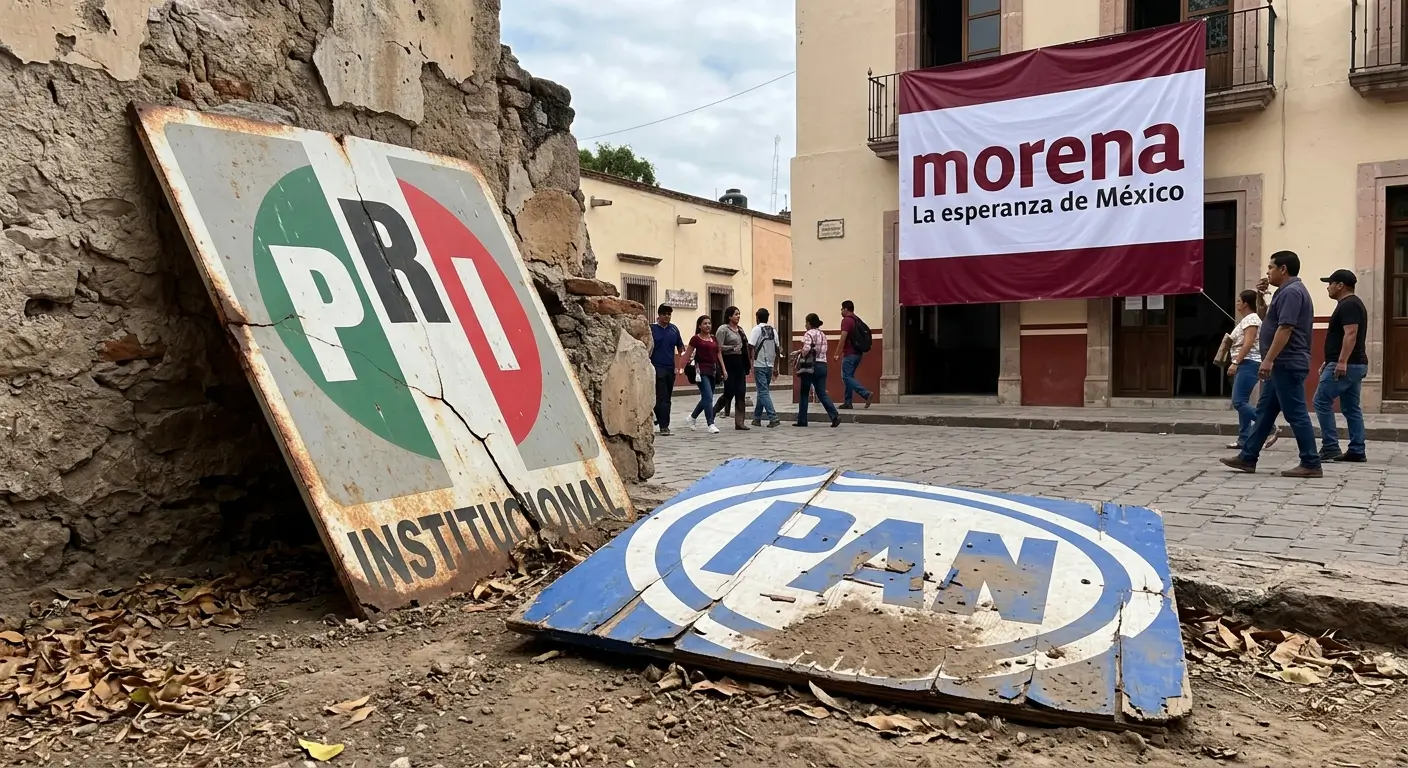
It seems that the intention of the NY Times with these types of stories is to strain relations between Mexico and the U.S., weaken the Mexican government, and torpedo the political project known as the Fourth Transformation represented by the Morena party. While it’s hard to tell exactly why, according to the book Manufacturing Consent: The Political Economy of the Mass Media (1988) written by Edward S. Herman and Noam Chomsky, their analysis of major U.S media outlets concluded that media bias is neither strictly liberal nor conservative, but rather aligned with corporate interests. This is unsurprising, given these media outlets are owned by the very corporations that provide their advertising revenue. In the case of The Times, the authors noted that it acts as a primary historical record, for that reason the paper must carefully curate what is included or excluded, dictate which questions are asked, and shape how events are interpreted. Ultimately, despite enduring controversies over bias since its founding in 1851, the paper maintains its status as a highly influential global media outlet.
However, constant criticism from Mexican authorities has exposed these journalistic shortcomings and the New York Times's blatant propaganda, hindering the newspaper's ability to influence public opinion. Even when these reports are amplified by major Mexican corporate media outlets and the right-wing opposition—which readily exploits foreign reports to undermine the progressive government—the strategy has backfired, as the underlying corporate and political motives have already been revealed.
Despite what The New York Times and other major mainstream media outlets want us to believe about being trusted sources, reality shows that they are becoming less and less influential. In the U.S., according to the Gallup Media Trust Index published on October 2025, trust in mass media has hit a record low, with just 28% of Americans expressing a “great deal” or “a fair amount” of confidence in newspapers, television and radio to report the news “fully accurately and fairly. This contrasts with 31% in 2024 and 40% five years ago. Meanwhile, 7 in 10 U.S. adults say that they have ‘not very much’ confidence (36%) or ‘none at all’ (34%). A similar trend is happening in Mexico, where overall media trust has fallen to 31% according to the latest Digital News Report. Therefore any media campaign that attempts to influence Mexico’s internal politics and affairs is doomed to fail.
Image: Gemini AI
Gabriel Infante Carrillo