Mexico
Sheinbaum Administration Highlights Two-Year Science Milestone with Record Funding Increase
Published:
Mexico
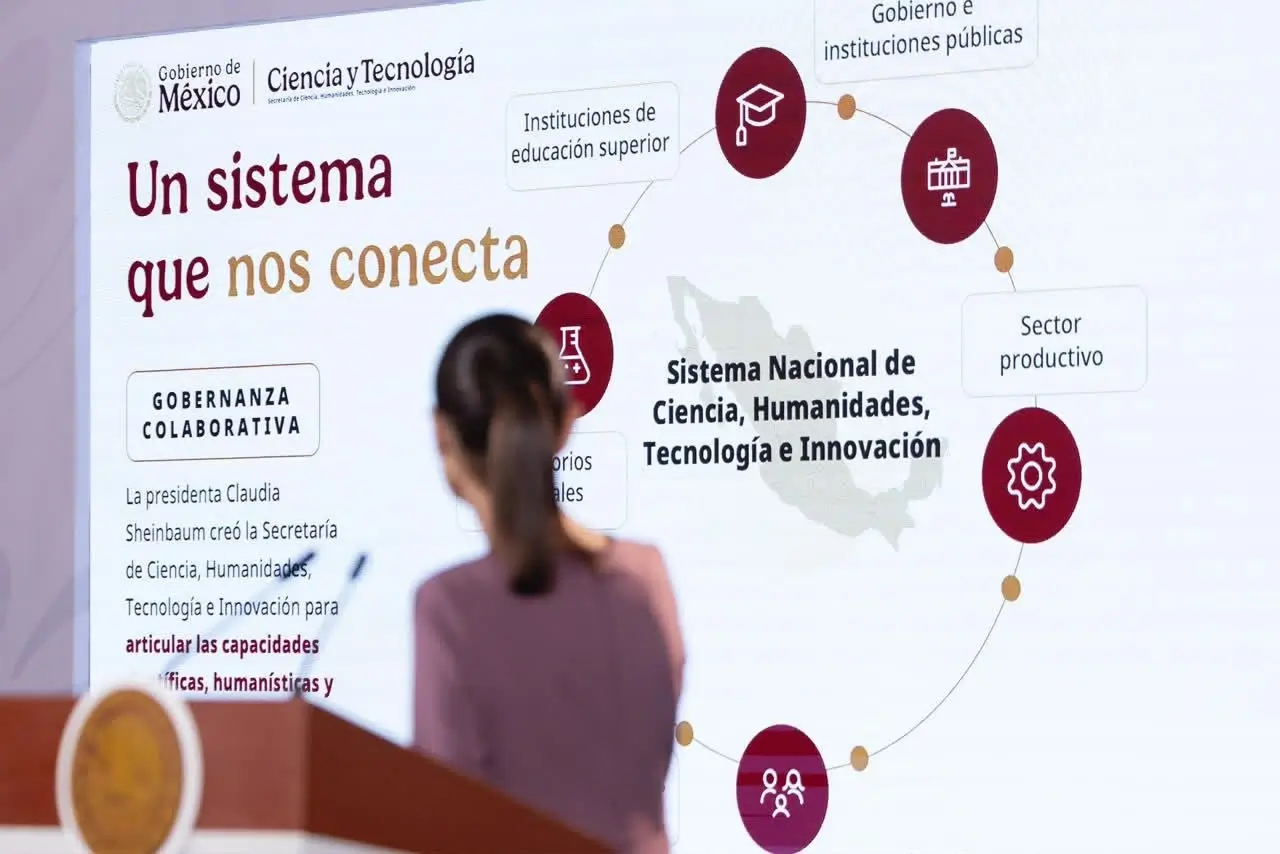
During President Claudia Sheinbaum’s daily press conference on Thursday, the head of the Secretariat of Science, Humanities, Technology, and Innovation (Secihti), Rosaura Ruiz Gutiérrez, presented an overview of the current administration's two-year record in the science and technology sector.
President Claudia Sheinbaum highlighted the impetus her administration has given to national development through a 111% increase in investment in the Science and Technology Research Fund—amounting to an additional 1.676 billion pesos ($92.149 million USD)—as well as through collaboration among researchers, institutions, and universities, and the establishment of concrete objectives. She noted that in addition to the budget increase, such an effort had rarely been made in the past regarding specific projects.
“It is the major innovation we are presenting—one that is already yielding results—because it involves very specific objectives for national development; now, we want many of these initiatives to transition into technological innovations and products that drive the national economy,” noted President Sheinbaum.
Meanwhile, Rosaura Ruiz recalled that the secretariat was established to replace the National Council of Humanities, Science and Technology (Conacyt) in order to unify the country’s scientific, humanistic, and technological capabilities. Between 2025 and 2026, approved projects grew by 48%, while grants and scholarships increased by 5.8%, backed by a 12.3% boost in overall funding.
Rosaura Ruiz explained and outlined the strategic projects for national sovereignty currently under development, which include:
Olinia: The first Mexican electric mini-vehicle, which is officially in its phase of production and distribution.
Kutsari: A project that boosts the semiconductor supply chain through National Design Centers in Puebla, Sonora, and Jalisco.
Coatlicue: The Mexican supercomputer and Latin America’s most powerful public supercomputer. Its development officially began in January 2026 with an estimated construction period of 24 months.
Power: Capable of processing 314 quadrillion operations per second (314 PetaFLOPS).
Infrastructure: Equipped with over 14,480 GPUs, equivalent to hundreds of thousands of computers working in tandem.
Investment: An estimated budget of 6 billion pesos ($332,534.04 USD).
Ixtli: An Earth-observation satellite constellation consisting of four CubeSat-type satellites (two nano-satellites and two micro-satellites in a low sun-synchronous orbit), developed by Mexico’s National Autonomous University (UNAM), the National Polytechnic Institute (IPN), and other public research centers.
Apixqui: A meteorological-oceanic monitoring and hurricane early-warning system developed by the Center for Scientific Research and Higher Education of Ensenada, the Mexican Navy, UNAM, and the National Meteorological Service.
Quetzal: An unmanned aerial vehicle system (UAV) developed by the Mexican Navy (SEMAR) in collaboration with Secihti and the Aeronautical University in Querétaro (UNAQ).
The Secihti also coordinates the national project for sargassum management and monitoring with the aim of the comprehensive use of sargassum to understand its origin and possible uses. It also coordinates the Corn and Bean scientific program; its primary objective is to ensure Mexico’s food sovereignty through the conservation and improvement of native crops, without altering their traditional genomes.
Mexico is also developing medical devices for dialysis and hemodialysis through an alliance between the Mexican Social Security Institute (IMSS) and Secihti—a project that represents a strategic priority for public health and technological sovereignty.
As for humanities, the priority projects are the strengthening of indigenous languages, local histories of the peoples and communities, and the Network for the Analysis of Discourse and Political Identities.
Furthermore, Rosaura Ruiz detailed that the Secihti coordinates a vast scientific and educational network, including: 108 National Laboratories; 27 Public Research Centers, which produced 1,355 graduates in 2025; 2,536 programs within the National System of Graduate Studies (SNP); 48,000 researchers in the National System of Researchers (SNII); 1,139 "Researchers for Mexico" integrated into various institutions; 100,000 scholarships and student grants; 28 Academic Units of the Rosario Castellanos University; 12 collaboration networks; 3,142 active research projects; and 13 strategic projects.
Additionally, the Secihti has secured 160 patents, representing 16% of the national total, while 4,838 individuals are actively dedicated to science, technology, and the humanities.
Image Gobierno de México
Voice of Mexico